
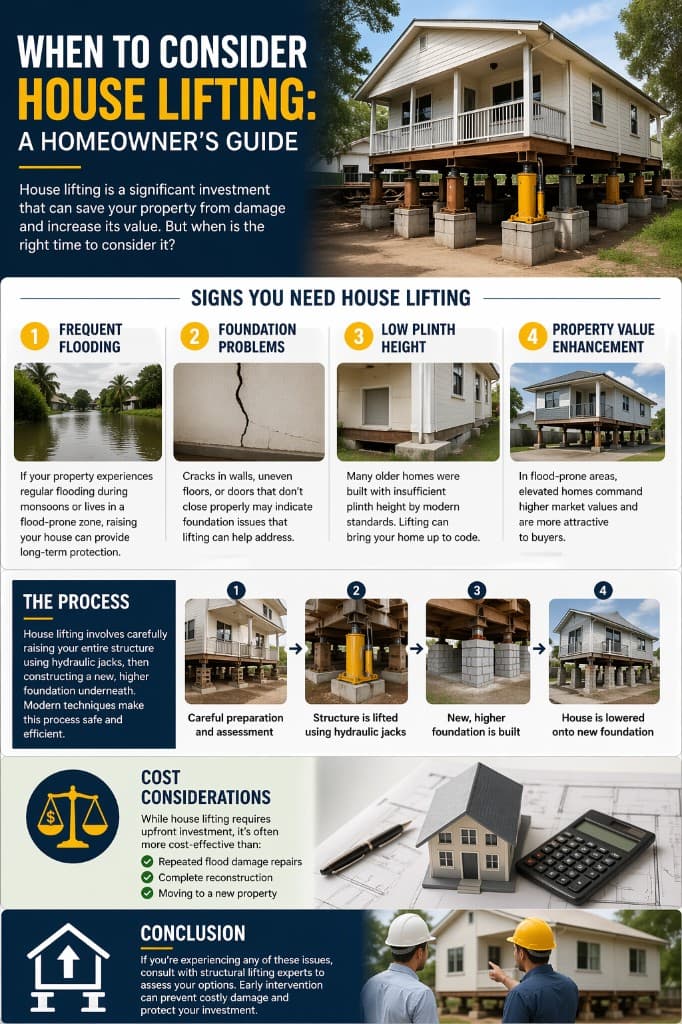
House lifting is a significant investment that can save your property from long-term damage and meaningfully increase its value. The hard part for most homeowners isn't the engineering — it's knowing when to act.
This guide walks you through the four classic signs that you should bring in a structural lifting team, what the actual lifting process looks like on site, and how the costs compare to the alternatives.
Signs You Need House Lifting
1. Frequent Flooding
If your property experiences regular flooding during the monsoon, or sits inside a known flood-prone zone, raising your house provides long-term, structural protection. Once the plinth is elevated above the historical flood line, you stop paying for the same damage every single year.
2. Foundation Problems
Cracks in walls, uneven floors, or doors and windows that no longer close properly are usually telling you the same story: the foundation has moved. House lifting lets us temporarily transfer the load off the foundation so it can be repaired, strengthened or completely re-cast — without demolishing the structure above.
3. Low Plinth Height
A large share of older Indian homes were built with insufficient plinth height by today's standards. Roads have been re-laid above the original level, drainage has shifted, and the house now sits below the street. Lifting brings the home back up to code and restores natural drainage around the property.
4. Property Value Enhancement
In flood-prone areas, elevated homes consistently command higher market values and are dramatically more attractive to buyers and tenants. A one-time lift often pays for itself in resale price alone.
The Process
House lifting is the careful, controlled process of raising your entire structure on a synchronized array of hydraulic jacks, then constructing a new, higher foundation underneath it. Modern equipment, computer-monitored level sensors and small phased increments make this safe and predictable when carried out by experienced engineers.
The four broad stages we follow on every job:
- Careful preparation, structural assessment and load mapping.
- The structure is lifted in 1–2 inch increments using synchronized hydraulic jacks.
- A new, higher foundation is built underneath using engineered cribbing.
- The house is lowered onto the new foundation and finishing work is completed.
Cost Considerations
While house lifting requires up-front investment, it is almost always more cost-effective than the alternatives — especially when you compare it to:
- Repeated flood damage repairs season after season.
- A complete teardown and reconstruction of the property.
- The hidden cost of moving to a new property in a safer location.
A single, well-engineered lift today is almost always cheaper than three or four cycles of monsoon damage tomorrow.
Conclusion
If you are seeing any of the four signs above on your own property, the right next step is a free site visit from a qualified structural lifting team. Early intervention is what separates a routine, predictable lift from an emergency repair — and it is what protects your investment for the next several decades.

